ASMFC ACTION REQUEST- Menhaden Amendment 3

© David Shupp
The Atlantic States Marine Fishery Commission’s menhaden management plan is being amended, and Stripers Forever strongly supports the concept that menhaden should be managed using Ecological Reference Points (ERP’s) with whatever models are available today. With abundance of Menhaden rising and the geographic range growing, the time to switch from “single species” to EBFM is NOW.
Public hearing dates are fast approaching. It is extremely important that the ASMFC hear from as many individuals as possible. If you are unable to make the hearing date near you, written comments will be accepted until 5PM EST January 4, 2017.
Please click here to view all coast-wide meeting dates, times and locations: Menhaden Public Information Document (PID) for Draft Amendment 3 Hearings
If you are unable to make the meeting near you, written comments will be accepted via mail, fax and email until 5PM EST January 4, 2017. For this information please see page (2) of this document: Public Information Document (PID) for Draft Amendment 3 Public Comment
Thank you in advance for doing your part!
The following letter was sent in by SF in support of this position:
12/8/16
Megan Ware
Fishery Management Plan Coordinator
Atlantic States Marine Fisheries Commission
1050 North Highland Street, Suite 200A-N
Arlington, Virginia 22201
To Whom It May Concern:
On behalf of the 5,000 members of Stripers Forever (SF) who support the sustainable management of striped bass and the ecosystem components that support them, thank you for the opportunity to comment on the Menhaden Amendment 3 PID.
This organization strongly supports the use of ecosystem based fishery management (EBFM) as the primary tool for the process of promoting long-term sustainability of our marine resources.
As outlined in the Menhaden Amendment 3 PID, we will comment on the issues in order:
ISSUE 1: Reference Points
SF strongly supports the concept that menhaden should be managed using Ecological Reference Points (ERP’s) with whatever models are available today. With abundance of Menhaden rising and the geographic range growing, the time to switch from “single species” to EBFM is now.
Currently, Option D is the best solution. Managing menhaden at 75% of the pre-industrial fishing stock size and requiring that the population never drops below 40% will allow sustainable harvest and help menhaden continue to expand back into the northern and southern extremes of their former range. Option D will enable the population to continue to grow, while increasing menhaden’s value to the recreational fishing, commercial seafood, and tourism businesses that all depend on this important fish, and its predators. Conservation will benefit everyone.
ISSUE 2: Quota Allocation
SF feels that the ASMFC should revise the current allocation formula. More fish should be allocated to the bait sector, taking into account historical catch and recognizing the important role of the bait sector in regional economies. One state or entity taking 85% of the catch is inequitable and is counter to recent NOAA guidance on allocation.
Three options have the most potential to provide a fair and equitable distribution of catch:
Option B: State-specific quotas with a fixed minimum. Option F: Disposition quotas with at least 30% of catch allocated to the bait sector. Option G: fleet capacity quotas, with all fleets managed by a hard quota. Options B, F, G strike the best balance between current needs and future growth.
Two options should be removed from Amendment 3:
1) Option C: Coast wide Quota. This will produce a race to catch fish, which will be unfair to some states, especially in the North. 2) Option E: Regional management adds an unnecessary layer to an already complicated fishery.
ISSUE 3: Allocation Timeframe
SF feels that by considering only 2009-2011 or 2012-2016, the Board is unfairly excluding the significant catch history of other states; especially in the Northeast where the assessment shows processing plants existed until the 1980’s. Catch data from as early as 1955 should be considered. A variation of Option C: Longer Time-Series Average, going back to 1985 or earlier would be fairer. Option D (2012-2016) should be removed from the Amendment, as it is simply reflects the status quo.
Issue 4: Quota Transfers and Overage Payback
SF supports the concept that quota transfers should be unrestricted ONLY if completed prior to a state exceeding its quota. A state receiving a quota transfer after exceeding its quota should be required to take action to avoid the overage in the following year and should not be allowed to accept a quota transfer in the following year.
ISSUE 5: Quota Rollovers
SF feels that quota rollovers should not be allowed. Rollovers may lead to unintended consequences with regard to localized depletion or quota allocation on a year to year basis.
ISSUE 6: Incidental Catch & Small Scale Fishery Allowance
SF feels that the current by-catch allowance is a loophole that allows millions of pounds of menhaden to be caught, but not counted toward the quota. This exemption was created to address a problem that should be eliminated under the allocation option being proposed in this action. All harvest MUST be counted.
ISSUE 7: Episodic Events Set Aside
SF feels that quota rollovers should not be allowed. Rollovers may lead to unintended consequences with regard to localized depletion or quota allocation on a year to year basis. SF feels that the episodic events set aside is unnecessary. A fair allocation and a quota transfer process that includes accountability is enough flexibility to manage expected fluctuations in local abundance of a sustainable fishery.
ISSUE 8: Chesapeake Bay Reduction Fishery Cap
The Bay remains the primary nursery for the coast wide menhaden population. It is the area where the majority of catch is concentrated. The cap should be kept in Amendment 3, but reduced to 96 million pounds (closer to current levels) to protect against localized depletion and provide for the ecosystem services that many predators depend on in the Bay.
ISSUE 9: Research Programs and Priorities
SF supports the idea that ASMFC should prioritize fishery independent research into historical abundance, effects of localized depletion, food web interactions and ecosystem services of menhaden.
Stripers Forever appreciates the opportunity to comment on the Menhaden Amendment 3 PID. There are a lot of important issues that need to be resolved. SF continues to believe that many of them will be resolved, if this important species is managed with EBFM.
Sincerely,
C.M.”Rip” Cunningham Jr.
Former Chair, New England Fishery Management Council
National Board Member, Stripers Forever
IMPORTANT ASMFC ACTION REQUEST
Menhaden Hearing: Attendance and Comments Requested
The ASMFC is considering updates to the Menhaden fishery management plan that will leave more fish in the water for predators like Striped Bass and Bluefish, and update state-by-state quota allocations.
For those of you who have been on the water this fall, you’ve seen huge bunker schools and hopefully got to enjoy some of the EPIC blitz fishing! It’s been an incredible fishing experience and even better for the health of the marine ecosystem. When was the last time anyone saw humpback whales in Perth Amboy or up the Hudson at the GW Bridge?!
To keep the progress rolling, we need to lock in this success by establishing “Ecological Reference Points, (ERP)” accounting for the needs of all predators. Now is not the time to risk taking a step backwards. We also need to make sure that that there is an equitable distribution of the catch. One company, Omega Protein, should not be allowed to get 80% of the fish to grind up for pet food and Asian aquaculture feed. The bait sector deserves a larger slice of the pie.
This document, created by Menhaden Defenders, gives a background summary and covers all major talking points: Menhaden Defenders Background and Talking Points
Please click here to view all coast-wide meeting dates, times and locations: Menhaden Public Information Document (PID) for Draft Amendment 3 Hearings
If you are unable to make the meeting near you, written comments will be accepted via mail, fax and email until January 4, 2017. For this information please see page (2) of this document: Public Information Document (PID) for Draft Amendment 3 Public Comment
Thank you in advance for doing your part!
Menhaden Defenders is a great group of conservation minded anglers and concerned citizens who want to restore Atlantic Menhaden to sustainable levels. For more news updates concerning Menhaden please visit their website and become a member.
Official Numbers: Maryland’s 2016 Striped Bass Young Of The Year
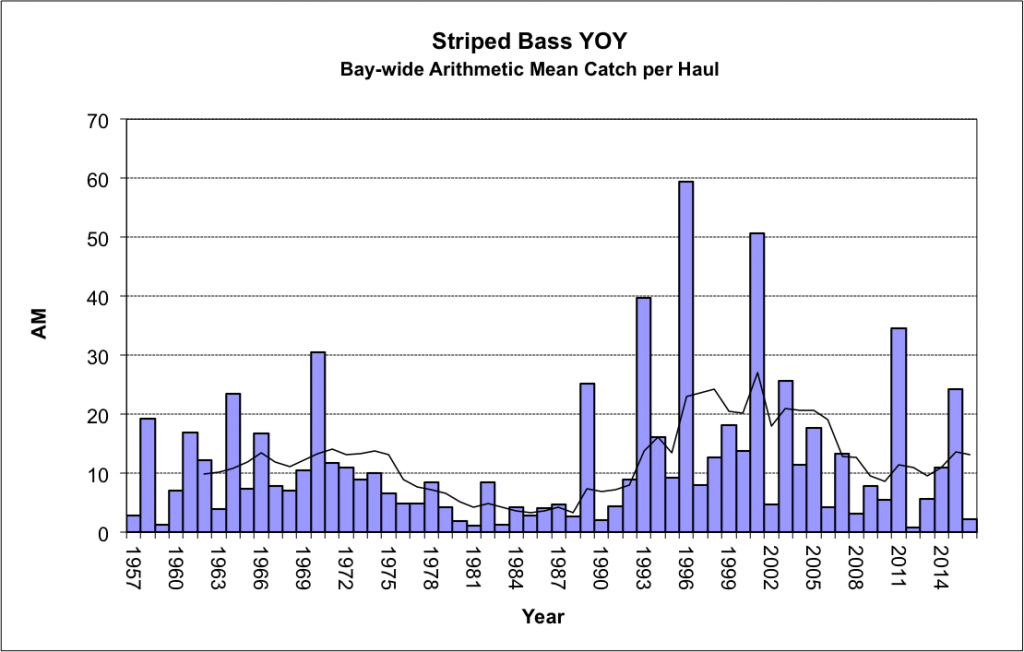
The official numbers are out on Maryland’s 2016 striped bass young of the year, and they aren’t good. This late summer count of striped bass born during the past spring is calculated annually by Maryland’s Department of Natural Resources by hauling a seine through essentially the same areas of Chesapeake Bay, at the same time, year after year. The number of baby bass caught in the net is averaged and a final count for the year is eventually calculated. In 2016 it was 2.2 which compares to a long-term average of 11.86. In fairness striped bass spawning success in the Bay has historically varied considerably on a year to year basis. But it is the trend that is worrisome. Here is the average YOY trend by decade since the recovery began from the collapse of the late 1970s:
· 1987-1996 17.3
· 1997-2006 16.2
· 2007-2016 10.9
This is a decline of 37% since the height of the recovery that gave us the great fishing of the late 90s and early 2000s. But what is more alarming is that two of the poorest years for young stripers in the last 30 – 2016 and 2012 – occurred during the last 5 years. In fact the average for the last 5 years is just 8.81 or about half of what it was during the top of the recovery.
Clearly the direction is not good. We cannot change these numbers and the abundance or scarcity of big bass available to spawn and to fish for 10 or 15 years from now will depend on how we treat these fish as they grow. If we gill net them in Chesapeake Bay, then start cropping them off commercially and recreationally at 28 inches in size, there certainly will be many less large spawners than there are right now, and the quality of fishing will continue to deteriorate.
In truth we are not talking just about numbers here but of the future of wild striped bass and how we choose to manage this shrinking resource going forward. This fishery and the billion dollar plus recreational striped bass fishing economy is threatened by the current, regulatory philosophy that undervalues the quality of the fishery in favor of harvesting. At present these fish are managed primarily for their limited commercial value and as long as these fish have a commercial price tag on their heads their future will always be in doubt. Only by declaring and managing them as a game species will they have a secure future…… and that is the goal of Stripers Forever: insuring a healthy and robust wild striped bass fishery.
U.S. Retreats on Fish Conservation for 1st Time in 40 Years
October 14, 2014 – Brad Sewell
The Magnuson-Stevens Fishery Conservation and Management Act turned 40 this year. And NOAA Fisheries, the federal agency that administers that law, reported coincidentally on Wednesday that forty ocean fish populations or “stocks” have now been rebuilt from depleted levels.
The prudent thing for NOAA fisheries to do at this point, one would think, is to stay the course. You would not expect that the agency would take this opportunity to weaken the guidance it gives to regional fishery management councils on making conservation and management decisions, like setting catch limits, right? But this is what happened yesterday. The agency announced that it had revised its “National Standard One” guidelines in order to give more “flexibility” to the councils.
To translate: flexibility means weakening in this context. It means allowing councils to set higher catch limits, thereby increasing the risk of overfishing and, in instances when a stock is depleted, slowing and possibly jeopardizing recovery. For example, the revised guidance allows catch level reductions to be phased in over several years, even if a stock is already overfished and the science indicates delaying catch reductions will increase the risk of overfishing. The revised guidance also provides more “flexibility” to undercount catch, to reduce conservation of individual species by grouping them with others, or to simply not manage species at all. And the agency confoundingly refused to define “adequate progress” in rebuilding a depleted stock—a finding that would trigger a revisiting of recovery efforts under the law—as including actually rebuilding the population level of the stock. This will allow stocks to linger at depleted levels, rather than requiring steps to be taken to ensure recovery.
This is the first time in forty years, since Magnuson was enacted in 1976, that the U.S. has weakened its fisheries conservation policy. Congress strengthened the conservation requirements in the law in 1996, adding requirements to rebuild depleted fisheries, because in too many instances, fishery managers used flexibility in the law to accede to pressure to allow unsustainable fishing. In 2006, Congress again strengthened the law to require catch limits to prevent overfishing. Most recently, in 2009, the Bush Administration strengthened the National Standard One guidelines to help implement the 2006 statutory amendments.
The stronger conservation requirements have paid off.
As NRDC’s 2013 “Bringing Back the Fish” report showed, nearly two-thirds of fish stocks placed in rebuilding plans had been rebuilt to healthy population levels or had made significant progress. Not only have 40 previously depleted fisheries been rebuilt to healthy levels, but the percentage of federal stocks known to be subject to overfishing has also dropped by more than half since 2006, from 20% to less than 10%.
The ecological recovery means economic recovery. In 2011, NOAA Fisheries estimated that rebuilding all U.S. fish stocks that year would have generated $31 billion more in sales, supported 500,000 more jobs, and increased the fishermen’s revenue at the dock by $2.2 billion.
Don’t get me wrong: there remains much work to be done. More than three dozen fish stocks (out of 233 tracked by NOAA Fisheries) remain overfished. Certain regions, like New England, the South Atlantic, and the Gulf of Mexico, have more than their fair share of these still-beleaguered fisheries. Hundreds of fish species that are less economically-important but still ecologically-important remain poorly or not managed. Habitat damage that impairs recovery of fish populations and harms ecosystems, discarding or bycatch of unwanted fish and other marine life, and ensuring sufficient forage fish for larger fish and marine wildlife like whales, sea birds, and sea turtles are just several of the other fishing-related problems still awaiting adequate solutions. And climate change is already making its impacts felt in the nation’s oceans, with waters off New England warming faster than virtually any other monitored marine water body in the world.
The revision of the National Standard One guidelines is a missed opportunity to help address these challenges and to maintain continued progress in the evolution of the nation’s fisheries management policy. At a bare minimum, the agency should have done no harm, given the existing policy’s overall success in recovering many of our nation’s most economically important fish populations and the sacrifice that this has entailed for many fishing communities.
Instead, NOAA Fisheries has retrenched. This is a distressing signal for the future of U.S. fisheries, for the communities that depend on them, and for ocean health.
article source: https://www.nrdc.org/experts/brad-sewell/us-retreats-fish-conservation-1st-time-40-years