ASMFC Addendum V to Amendment 6 Voted Down 10-5

On Tuesday May 9, 2017, the Atlantic States Marine Fisheries Commission debated on whether or not an increase in Striped Bass harvest of about 10% should be allowed for next year. The motion to take the increase out to public hearings failed 10 votes to 5. Hooray! NJ, DE, MD, VA, and the Potomac River Fisheries Commission – a shill organization that simply provides the Chesapeake Bay states an extra vote – all voted in favor, and all other states voted against. What changed from the first vote was that CT, NY, NC all changed their votes from yes to no, and that did it for us.
Why the change of heart from last winter when this idea was dreamed up? I think in the final analysis there were three reasons. The first was that the actual catch is hard to predict. The catch was thought to have decreased considerably on the coast but had actually increased in the Chesapeake Bay area, and these were the same people who wanted still more. It didn’t sell well. The scientists predicted that there was a very good chance that the catch in 2018 would actually increase by more than 10% even with no change in regulations. This was because of an increased number of fish in certain year classes that both the Bay and the coast are expected to fish on, and lastly because a stock assessment with a lot of new science is being proposed for 2018. Many thought it was likely that even if a change was made this year it would probably be changed again – perhaps reversed – next year.
In any case we dodged a bullet, and I hope our advocacy was helpful. This reprieve will give us a chance to see another year class born in the Chesapeake Bay before the issue is tackled again. Some of the recent YOY have been poor, but the trend isn’t really conclusive because there are also occasionally really good ones. The science is also evolving. During the meeting there was a discussion about the new science methods, and they are talking about some of the complicated aspects of the old models that we have long had issues with. I’m sure that all of the problems won’t be fixed, but perhaps the population estimates will get better and more reflective of what we actually see on the water. Along with the new science was a discussion about perhaps designing various stock reference points and management triggers to reflect a different set of values for the fishery, and how this will be an opportunity to take a new look at just how and for what values the striped bass fishery should be managed. Hopefully we will be able to influence this process to achieve more recognition of the socio-economic value of high quality angling.
Science and advocacy matters. Thanks to everyone who wrote and lobbied for no increase in the regulated harvest. Alone a single voice is nearly silent but together we have raised an awareness of the need to protect and conserve. I believe we have pricked and awakened the latent conscience of many regulators that are beginning to realize that no longer will the recreational fishermen and women silently allow commercially vested interests to destroy what is our fishery too.
Brad Burns, President
Stripers Forever
ACTION REQUEST: ASMFC Addendum V to Amendment 6 to Liberalize Management Measures
Commercial interests are again demanding higher kill limits on striped bass. Chesapeake Bay area commercial fishermen want to roll back the conservation measures put in place in 2013 and return to the harvest levels that caused coast-wide recreational catches to decline by up to 90%.
On May 9th the Striped Bass Board of the Atlantic States Marine Fishery Commission will consider whether or not to send this request for a larger striper kill out to public hearing. We must act now and request that the ASMFC commissioners vote down this increase.
The recreational catch coast wide has dropped from a consistent 9 to 10 million fish in the early 2000s to 3 to 4 million in recent years. This 65% or so drop in the average recreational catch has cost multiple times as many jobs in the recreational fishery as all the commercial striped bass fishing jobs that have ever existed. Stripers should be managed for the far more socio-economically valuable recreational fishery, and that means more fish left in the ocean not less.
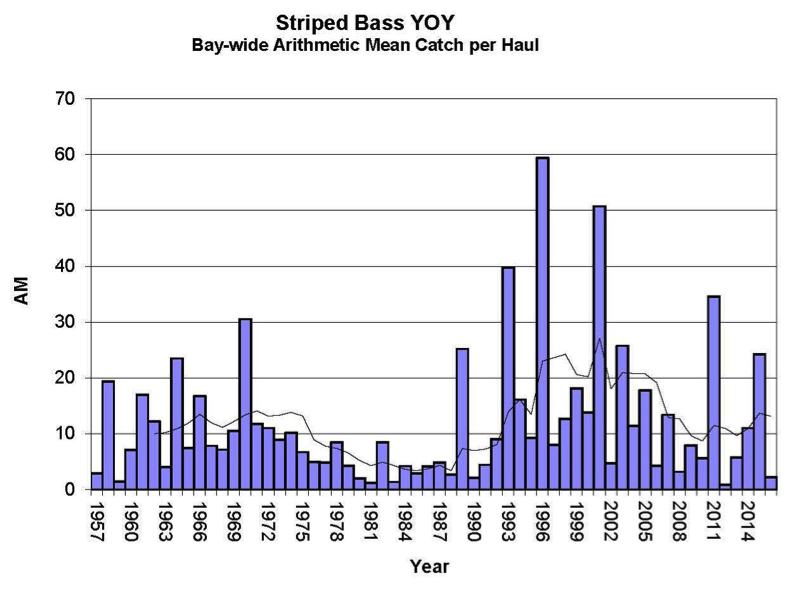
The chart above shows that under the higher catch limits the Chesapeake Bay year classes have become progressively less consistent and that the trend line for spawning success is down. We also know that the number of really large striped bass in the population is way down from the early 2000s. That was why the catch limits were all reduced just 3 years ago, and we should never return to those harvest levels.
So why is the ASMFC contemplating this move? The answer is simple, because the commercial fishing community in Chesapeake Bay has the governor’s ear, and the Maryland fishery executive on the striped bass board is charged with doing his best to get more fish for the state’s commercial striper fishery. We need to do our best to stop this from happening.
Our effort starts with getting the states that we each live in to vote in favor of fisheries conservation. The vote last time was close. However, both New Jersey and Connecticut voted in favor of the increased catch. Why? God only knows, but we need to tell the Governors of these states plus each state’s representatives on the ASMFC that we want good fishing, and do not want to return to the fishing mortality levels that so drastically reduced the stocks.
Here is how you can help: The Progress Map & State Info page on our website contains links to each state with regulations, quotas and important contacts for that state. You will find email addresses for all of your representatives to the ASMFC. Your state’s governor will either have an email address or link to a webform.
- Copy and paste the brief note below into an e-mail with the copied email addresses for your state pasted into the [To:] field. In the [Subject:] field enter “Striped Bass Conservation”. Please change the message as much as you want into your own words or thoughts.
- We also ask every member of Stripers Forever, no matter what state you live in, to send this letter to the governors and ASMFC representatives of Maryland and Virginia. It’s easy, with one e-mail all of this takes just a few minutes and makes a huge difference.
COPY THIS MESSAGE INTO YOUR EMAIL:
To Whom It May Concern,
The quality of our striped bass fishery is very important to me. I do not want to see striped bass harvest levels returned to the levels of 2013 because I believe those levels will just continue to degrade this fishery. Striped bass are a great game fish and good fishing is extremely valuable to the 3,000,000 people who angle for stripers along the Atlantic coast. We don’t want striped bass to become just another depleted commercial species. Please vote no on Addendum V to Amendment 6.
Thank you,
XXXXXXX
ASMFC New Release- February 3, 2017: Draft Addendum V to Amendment 6 to the Atlantic Striped Bass Fishery Management Plan
ASMFC Addendum V to Amendment 6 to Liberalize Management Measures
An important development is underway in striped bass management. The main thrust of this movement comes from the Chesapeake Bay states. Fishery managers from this area are claiming economic hardship for their commercial fishermen due to the 20% reduction in quota that they took two years ago in reaction to a declining spawning stock biomass and sporadically poor spawning success. They want to resume catching striped bass at the levels that were allowed prior to this reduction.
At the winter meeting of the Atlantic States Marine Fisheries Commission this point of view was voiced and a vote was taken to consider an addendum to the fishery management plan that would allow the increase. The northern states, which have arguably seen the greatest decline in their overall striped bass fisheries, would be expected to oppose such a proposal. Those states recognize that the quality of striped bass fishing has declined significantly since its peak 15 years ago, and they want to see the stock rebuild. Surprisingly, Connecticut and New Jersey, both game fish states, cast their votes with commercial interests to allow more stripers to be caught and killed. The result was very close, with just one vote causing the proposed addendum to move to the next phase of consideration. This is a clear demonstration that in some cases the people who find their way into ASMFC advisory roles do not support the views of the fishing communities they are supposed to represent.
The Stripers Forever Angler Surveys have shown continuous erosion of angler satisfaction with the striper fishery. Spawning success in Chesapeake Bay has been very sporadic. This past year was again one of the lowest years on record for baby stripers. The striped bass spawning stock continues to erode and may very well now be below the target levels set by the ASMFC to provide a sufficient component of large female bass. It is most certainly not a time when we should be returning to higher catch levels.
The commission will vote on the addendum at their spring meeting, which begins May 8th, 2017. Shortly before this meeting we will supply our members with names and contact information of ASMFC commissioners and a more detailed view of the reasons to oppose this increased kill. We will ask you to join us in contacting the members of the ASMFC and also the governor in your state – make no mistake, the governor’s office is where the move in the Chesapeake Bay area is coming from, and letting them know how you want them to vote on this ill-conceived addendum. In the meantime, if you know your ASMFC representatives or people of political influence in your state – especially CT and NJ – let them know how you feel about this issue.
ASMFC New Release- February 3, 2017: Draft Addendum V to Amendment 6 to the Atlantic Striped Bass Fishery Management Plan
2016 Annual Angler Survey Results
The results of the Stripers Forever 2016 Annual Fishing Survey are finalized, supporting documents are below this commentary. In 2016 we received 684 responses to our annual survey. This was an increase of 27 from last year. This year’s survey has again produced a good representative sampling of sentiments from fishers all along the striper’s migratory range, and as usual MA and NJ vied for the greatest contributions with 174 and 149 completed surveys respectively.
2016 saw an uptick in angler sentiment. Only 66% of anglers said that they caught fewer or many fewer stripers compared to 82% in 2015 and 85% in 2014. Overall angler sentiment was still quite negative, but it is clear from the responses that the increased numbers of smaller fish found here and there along the coast in 2016 were welcome.
66% said they were catching smaller fish compared to 73% and 71% for 2015 and 2014. It will be interesting to see how this sentiment develops over the next few years, since the average year classes providing the fish now coming in to coastal keeper size are on average much smaller than those from the earlier stages of the recovery. 2016 was another year of very low production of new stripers in Chesapeake Bay.
We again asked our members about what they were seeing from the 2011 year class. The results were that 78% in 2016 compared 84% in 2015 felt that this year class was appearing in the fishery at levels well below those that one would expect. Only 22% of 2016 respondents felt that the 2011 year class was evident at levels expected from such a huge year class.
Answers to questions about the need for a slot limit of smaller-sized stripers, and what percentage of the current commercial quotas should be reallocated to recreational quotas, show that our members continue to believe we should not be harvesting large, breeding stripers, that they want to set aside a high percentage of the current commercial catch for conservation – and not harvest it themselves. 77% of our members – up slightly from 75% in 2015 – said that they are willing to buy a stamp to finance the buyout of the commercial fishery.
We had survey results from 64 guides, up from 61 in 2015. Without a doubt the decline in striper fishing is hurting this valuable industry as well as the related fishing tourism and tackle businesses. The guides know how to fish their areas, though, and can usually produce the best results possible from their home waters. If you are thinking about a guided trip please check out the guides and tackle shops listed on the Stripers Forever website. We recently called all the guides on the list and removed those that we could find who had dropped out of the business. We are always adding new ones and welcome new applications. Just send us an e-mail at stripers@stripersforever.org.
We will send this information to the press and fishery policy makers everywhere. We hope that you will use this information personally to help us advocate for the goal of coast-wide striped bass game fish. Please share the results with your local fishing club, hometown newspaper, and elected officials that you may know.
- Annual Angler Survey- Results & Comments- 2016
- Annual Angler Survey- Results & Comments (Survey Monkey Bar Graphs)- 2016
- Annual Angler Survey- Angler Comments On Managing Striper Fishery- 2016
- Annual Angler Survey- Guide Comments- 2016
- Annual Angler Survey- Key Comparisons 2003-2016
If you have any questions about the survey please don’t hesitate to e-mail us at: stripers@stripersforever.org